
Choose Your Health Mystery-Solving Adventure (Because "normal" lab results shouldn't read like fiction)
Whether you're just starting your health investigation or looking for more clues, I've got a treasure trove of resources to help you understand what's really going on with your body. No secret decoder ring required!

What's Bugging Your Thyroid

Your Cellular Real Estate Is Under Attack Those "perfect" lab results are telling fairy tales while your cellular tenants are filing complaint after complaint. Your thyroid - the master property manager of your metabolism - is being sabotaged by unwelcome squatters and toxic materials that have slipped past inspection.
Think of it like this: Your thyroid isn't just malfunctioning on its own. It's being bugged by uninvited guests that have set up camp in your cellular neighborhood, causing all sorts of disturbances.
Decode Your Labs Guide

Stop staring at those "normal" lab results like they're written in hieroglyphics! Get my free guide to understanding what those numbers are really trying to tell you.
Hot Flash And Cold Facts

Hot Flashes & Cold Facts: Breaking Free from the "Just Deal With It" Myth
Dear Amazing Woman on Your Menopause Journey,
Remember when you used to bounce out of bed, ready to tackle the day with energy and clarity? When you felt like yourself - confident, sharp, and in control of your body?
These days, you're wondering where that version of you disappeared to, aren't you?
Craving Control Playbook

Learn the secret signals behind your cravings and how to respond without relying on willpower alone. Science meets strategy in this practical guide!
Health Detective Case Files Latest investigations into what's really going on with your health...
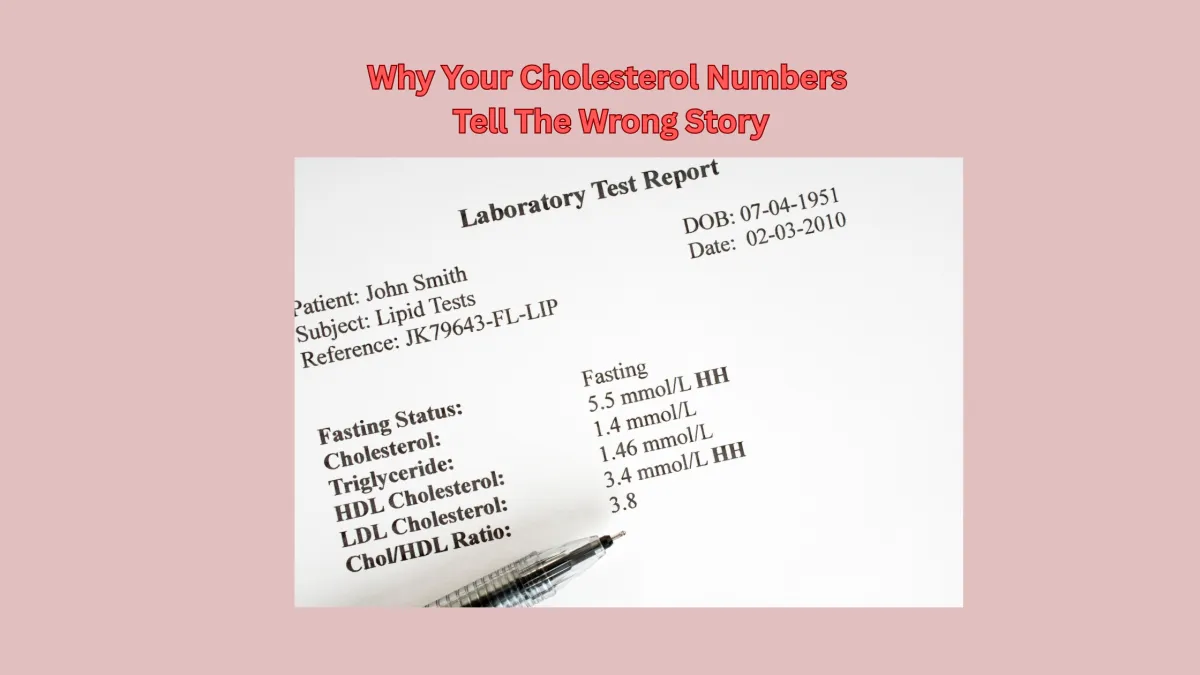
Why Your Cholesterol Numbers Tell the Wrong Story
Why Your Cholesterol Numbers Tell the Wrong Story
"My doctor wants to put me on a statin."
Jennifer was 52, sitting in front of me with her lab report, looking frustrated and confused.
"My total cholesterol is 220, and my LDL is 145. She says I'm at risk for heart disease."
I looked at her complete lipid panel. Then I asked the question her doctor never did:
"What's your triglyceride level?"
"Um... 180. She said that was a little high but not terrible."
"And your HDL?"
"42. She said that was fine."
I did the math in my head. Triglyceride/HDL ratio: 4.3.
"Jennifer, your doctor is focused on the wrong numbers. And that statin isn't going to address what's actually broken."
The Cholesterol Story You've Been Told
For decades, we've been fed a simple and dangerous story about cholesterol and heart disease:
High cholesterol = bad.
Lower cholesterol = good.
LDL is the enemy.
Statins are the answer.
It's clean. It's simple. It fits on a prescription pad.
It's also wrong. It's also dangerous. It has also made people fear nourishing foods.
That "story", is wildly incomplete. And that incomplete story is why women like Jennifer get put on medications that don't address their real cardiovascular risk.
The Gold Nuggets Your Doctor Isn't Looking At
Here's what makes me righteously angry: Your doctor orders a lipid panel. You get numbers for total cholesterol, LDL, HDL, and triglycerides. But then they only look at two of them - total cholesterol and LDL.
It's like being handed a map with four roads clearly marked, and only paying attention to two while ignoring the ones that actually tell you where you're going.
Let me show you what I mean with Jennifer's labs:
Total Cholesterol: 220 mg/dL
- Standard range: Below 200 is "desirable"
- What this actually tells us: Almost nothing about heart disease risk
LDL Cholesterol: 145 mg/dL
- Standard range: Below 100 is "optimal" these can only be artificially reduced with drugs
- What this actually tells us: Also not much, because we're missing critical context
Here's what her doctor completely ignored:
Triglycerides: 180 mg/dL
- Standard range: Below 150 (she's elevated)
- Optimal range: Below 70 (she's more than double)
- What this actually means: Metabolic dysfunction and insulin resistance
HDL Cholesterol: 42 mg/dL
- Standard range: Above 40 (she's "fine")
- Optimal range: Above 60 for women (she's low)
- What this actually means: Poor metabolic health
Triglyceride/HDL Ratio: 4.3
- Optimal range: Below 2.0
- What this actually means: She's at significant risk for insulin resistance and heart disease
That ratio? That's the gold nugget. That's the detective work that predicts cardiovascular risk better than LDL cholesterol alone.
The Story Your Cholesterol Particles Are Actually Telling
Here's what most doctors don't understand, or don't have time to explain: It's not about how much cholesterol you have. It's about what kind you have and why it's there.
Think of cholesterol particles like cars on a highway. Your total cholesterol is like counting how many cars are on the road. Your LDL is like counting a certain type of car.
But what really matters is:
- How big are those cars? (Particle size)
- How many are there really? (Particle number)
- Why are they all there in the first place? (The root cause)
Small, dense LDL particles are dangerous. They can penetrate arterial walls and cause inflammation and plaque formation. Large, fluffy LDL particles? Not so much. They're too big to cause the same damage.
But standard cholesterol tests don't tell you particle size. They just give you a total LDL number that lumps everything together.
It's like your doctor saying, "You have 100 vehicles on your highway" without telling you if they're tiny motorcycles that can weave through cracks or giant buses that stay in their lanes.
The Metabolic Dysfunction Your Doctor Is Missing
Here's the real story hiding in Jennifer's labs:
Her elevated triglycerides and low HDL weren't random. They were symptoms of insulin resistance - the same root cause issue we talked about last week with blood sugar.
When you're insulin resistant:
- Your liver produces more triglycerides
- Your HDL cholesterol drops
- Your LDL particles become smaller and denser (more dangerous)
- You develop chronic inflammation
- Your risk of heart disease skyrockets
And here's the kicker: A statin will lower Jennifer's LDL number. It might even lower her total cholesterol. But it won't address her insulin resistance. It won't address why her body is producing those dangerous small, dense LDL particles in the first place.
It's symptom management, not root cause investigation.
The Inflammatory Markers That Actually Predict Heart Disease
When I work with clients like Jennifer, I want to see markers that most doctors never even order. If her doctor is open to it, I ask for:
High-Sensitivity C-Reactive Protein (hs-CRP)
- Measures systemic inflammation
- Elevated hs-CRP predicts heart attack risk independent of cholesterol levels
- Optimal: Below 1.0 mg/L
Homocysteine
- Elevated levels damage arterial walls
- Connected to B-vitamin status and methylation
- Optimal: Below 7 μmol/L
Fasting Insulin
- The gold nugget for metabolic health
- Predicts insulin resistance years before blood sugar rises
- Optimal: 2-5 μIU/mL
Hemoglobin A1C
- Three-month average of blood sugar
- Elevated A1C = chronic inflammation and arterial damage
- Optimal: Below 5.3%
These markers tell the real story. They reveal the metabolic dysfunction and inflammation driving cardiovascular risk. And they're the markers that guide real solutions.
What We Actually Did for Jennifer
Jennifer didn't want to go on a statin. She wanted to understand why her body was producing these patterns in the first place.
So here's what we did:
Step 1: Analyzed Her Existing Labs with Optimal Ranges
We looked at the Complete Blood Count and metabolic panel her doctor had already ordered. When her doctor was willing to add inflammatory markers and fasting insulin, we got even better data.
Step 2: Identified Her Root Cause
Jennifer's triglyceride/HDL ratio of 4.3 and her other patterns pointed clearly to insulin resistance. Her body was chronically inflamed and metabolically dysfunctional.
Step 3: Addressed What Was Actually Broken
We didn't focus on lowering cholesterol. We focused on:
- Improving insulin sensitivity through targeted nutrition
- Eliminating foods that spiked her blood sugar and triggered inflammation
- Supporting her body's natural ability to regulate lipid metabolism
- Addressing nutrient deficiencies affecting her cardiovascular health
No statin. No symptom management. Just root cause investigation and correction.
Eight Months Later
Jennifer's follow-up labs were remarkable:
- Triglycerides: 68 mg/dL (optimal!)
- HDL: 65 mg/dL (optimal!)
- Triglyceride/HDL ratio: 1.0 (optimal!)
- Fasting insulin: 4.8 μIU/mL (optimal!)
- hs-CRP: 0.6 mg/L (optimal!)
Her total cholesterol? Still 215. Her LDL? Still 140.
But here's what matters: Her particle size had shifted to large, fluffy, non-dangerous LDL. Her inflammation was gone. Her metabolic health was restored. Her actual cardiovascular risk had plummeted.
And her doctor? "Well, your other numbers look great. I guess we can hold off on that statin."
The Questions You Need to Ask
If your doctor has told you that you need a statin based on your cholesterol numbers, here are the questions you need to ask:
1. What's my triglyceride/HDL ratio?
2. What's my fasting insulin level?
3. Have we checked inflammatory markers like hs-CRP?
4. Could insulin resistance be driving these cholesterol patterns?
5. What happens if we address the root cause instead of just lowering the number?
Your doctor isn't the enemy. Your doctor is working within a system that prioritizes quick fixes using drugs over root cause investigation. A system that measures success by whether your LDL number goes down, not whether your metabolic health improves.
But you deserve better than symptom management.
The Truth About Heart Disease Risk
Heart disease isn't caused by cholesterol. Heart disease is caused by chronic inflammation, metabolic dysfunction, insulin resistance, oxidative stress, and arterial damage.
Cholesterol is there at the scene of the crime. But it's not the criminal. It's the firefighter showing up to put out the flames.
Lowering your cholesterol with a statin is like arresting the firefighters and declaring the fire solved.
This is Heart Health Month. The question is: Are you going to manage a number, or are you going to investigate why that number exists in the first place?
Ready to find out what your cholesterol numbers are really saying?
Let's analyze your labs with optimal ranges and find the real story.
Schedule your Functional Bloodwork Assessment here.
À bientôt,
Juliana

Join the Health Detective Squad!
Get weekly health mysteries solved right in your inbox:
Lab result decoding tips
Energy-boosting strategies
Brain fog clearing techniques
Plus, first dibs on new workshops!
Nutrition Wellness Center Juliana Mazzeo, M.S., CDN, FMHC
1091 Rockaway Avenue, Valley Stream, NY 11581 (Corner of Rockaway Avenue & Horton Avenue)
Virtual appointments available three days a week
© Copyright 2026 | All Rights Reserved Nutrition Wellness | Terms & Conditions